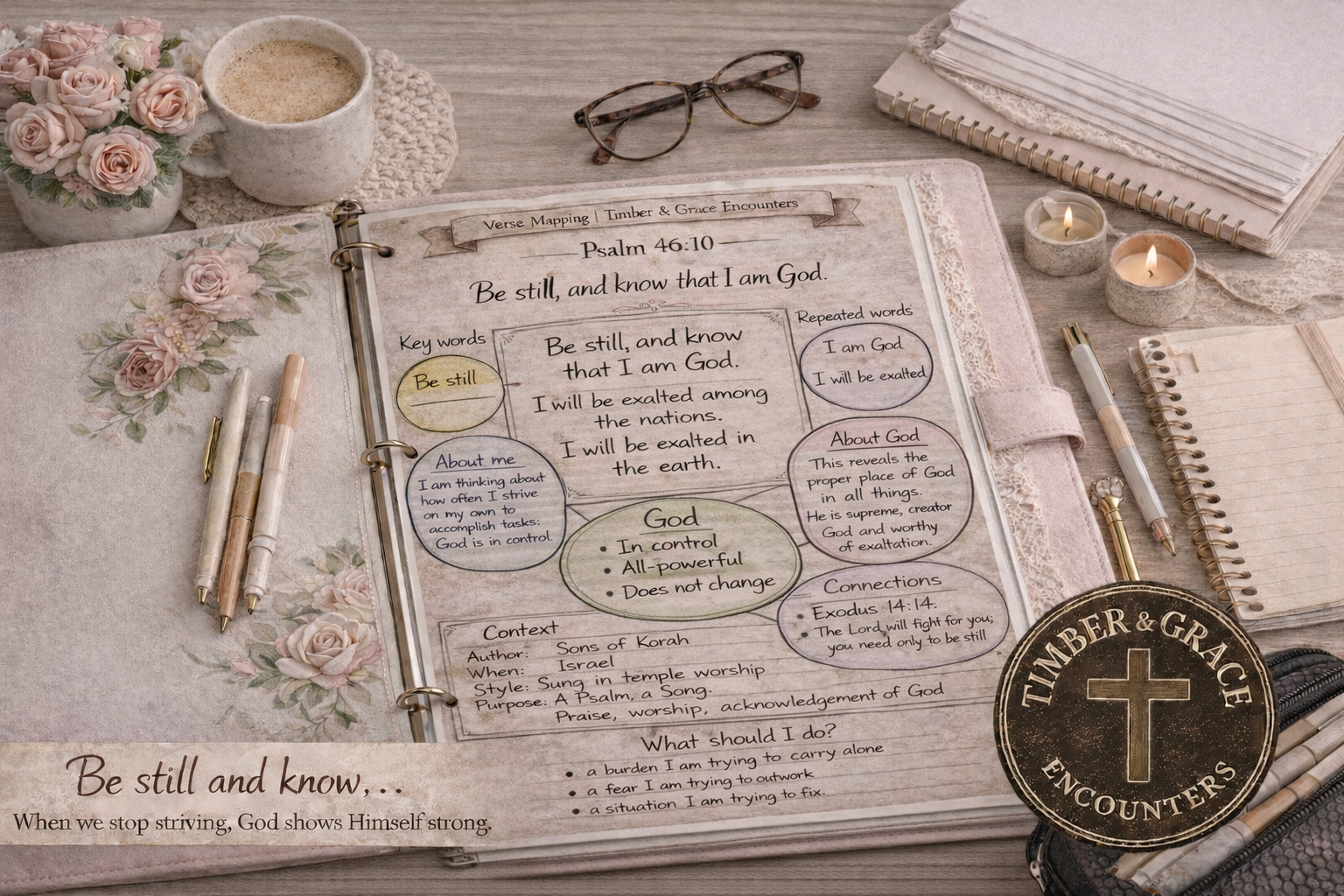
‘Be Still and Know’ Devotional is based on Psalm 46:10 and features a new verse-mapping tool in our Resource Library (PDF), which you can download and use.
This week, we’re launching our verse-mapping tool, starting with Psalm 46:10. This verse is featured on our homepage for a reason. It invites us not just to read Scripture, but to dwell in it, examine it, and allow it to speak into our lives.
Most of us have heard this verse and understood it as an encouragement toward quiet time, prayer, and resting in God:
“Be still, and know that I am God.”
And that is true. Stillness does include prayer, reflection, and drawing near to Him. But the word still carries a deeper meaning than simple quietness. In Hebrew, it means to cease, to let go, to stop striving, to release control. It is a call to stop exerting our own effort as if everything depends on us.
It is not merely an invitation to sit quietly.
It is a call to stop competing with God for control.
Throughout the Old Testament, we see a powerful pattern: God reveals Himself not when people strive, but when they stand back and watch.
In Deuteronomy 4:35, Moses reminds Israel: (For further context, read Deuteronomy 4:32-39)
“To you it was shown that you might know that the LORD is God; there is no other besides Him.”
They did nothing to make these things happen. God acted. They witnessed. And through that, they knew.
In 1 Kings 18:39, when fire fell from heaven and God answered Elijah’s prayer, the people fell on their faces and cried: (For further context, read 1 Kings 18:36-39)
“The LORD, He is God!”
Again, they did nothing. God revealed His power, and their knowing came from what they saw and experienced.
This is the same knowing spoken of in Psalm 46:10 —not a casual, informational knowing, but an experiential, undeniable knowing.
The kind of knowing that comes when God shows Himself mighty and it is unmistakable.
He reveals Himself as Jehovah Elohim: the Creator God of Genesis 1:1, the One who created everything from ‘no-thing’, the all-powerful, self-existent, unmatched God.
And that is why striving is so misplaced. Why do we struggle so hard to control what belongs to the Creator?
Psalm 46:10 could honestly be thought of this way:
“Stop striving and come to know—by experience and by undeniable evidence—that I am God.”
Stillness is not weakness.
Stillness is surrender.
And surrender is the doorway to seeing God work.
This is why verse mapping matters. When we slow down and examine even one verse, its meaning comes alive. We move from what is often familiar to our understanding, to now experiencing.
But this verse also gently asks us a question: What am I striving to control that God is asking me to lay down?
Maybe it is: a burden you are trying to carry alone, a fear you are trying to outwork, a situation you are trying to fix.
Psalm 46:10 invites us to stop striving so God can show Himself strong. When we release our grip and lay it down, or let go of it, we make room for His power to be revealed in our lives.
This week, as you use the verse-mapping sheet, don’t rush. Reflect. Study and then prayerfully ask God:
“What do I need to lay down so I can truly know God—not just in theory, but by experience?”
That is where stillness takes on a powerful meaning in your life! Be still and know!
Please visit our Resource Library for further devotional content and free tools you can download (PDF) for verse mapping
Leave a Reply