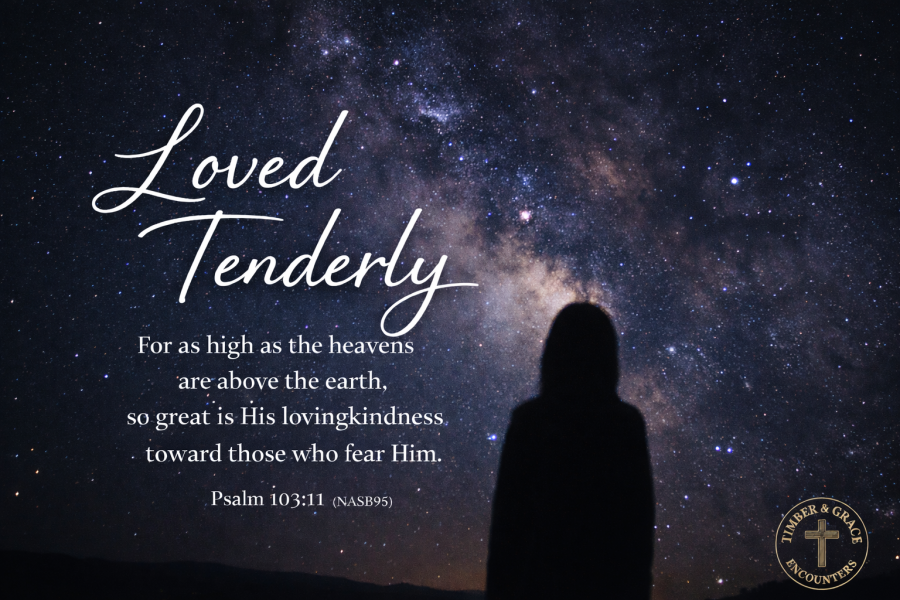
Psalm 103:11
“For as high as the heavens are above the earth,
so great is His lovingkindness toward those who fear Him.”
Read Psalm 103 and then explore,
‘So great is His Lovingkindness
-Loved Tenderly’
Just how high are the heavens?
How great is God’s lovingkindness?
And what does that mean for me, right here, where I am?
Psalm 103 is a testimony of who God is toward His people. It speaks of mercy, forgiveness, compassion, and patience. It is not indiscernible theology—it is personal, relational, and grounded in lived experience with a merciful God. And this psalm gives us the answers we are seeking.
David declares that God’s lovingkindness is as high as the heavens above the earth. At first, we may think of the heavens as what we can see when we look up. But even the heavens we know—the sun, moon, stars, and galaxies—are largely unseen without aid. And beyond all of that lies a heaven we cannot see at all: the dwelling place of God Himself.
David chose a comparison that is beyond human sight and beyond human measurement. It reminds me that God’s lovingkindness—His mercy—is not something we can fully perceive or contain. It is something we receive by faith. And yet, though unseen, it is certain—just as sure as the dawn.
It is no accident, then, that Scripture describes this lovingkindness as great. Words like this can feel familiar, even ordinary, until we slow down and hang over them a bit. But when Scripture uses the word great, it is inviting us to think beyond what can be measured, managed, or fully understood. The greatness spoken of here is not simply excellence or abundance as we often mean it in modern English.
The Hebrew word carries the idea of strength—of prevailing, of overcoming, of proving victorious.
God’s lovingkindness is not passive or fragile. It does not merely exist at a distance.
It prevails. It is triumphant. It wins.
Think on this:
His mercy is powerful enough to overcome what asserts itself over us—our sin, our weakness, our fear. It does not remain lofty and untouchable because it is as high as the heavens. No, it meets us at ground level, where life is lived and battles are fought.
This greatness is not optional. Without it, we would be undone. Again, we are reminded of what Scripture calls this mercy—ḥesed—God’s love in action. It is love that rescues, redeems, pursues, and preserves. It is not pity that is purely sentimental; it is intervention.
A.W. Tozer reminds us that in the Old Testament, mercy is God stooping in kindness—actively compassionate. This word originally carried the sense of a verb: to compassionate. Not static but moving. It acts. It does something.
It compassionates.
And this leads us to the question that matters most:
Why does God love us this way?
David answers plainly:
“As a father has compassion on his children,
so the LORD has compassion on those who fear Him.
For He knows our frame;
He remembers that we are dust.”
Psalm 103:13–14
God’s lovingkindness and mercy truly are—no guessing. They are powerful. They are victorious. And they are so because He knows us—because He formed us.
He remembers that we are dust—frail, limited, and bent toward weakness. He knows our imperfections, our susceptibility to temptation, and that perfection is not attained here.
And knowing all of this, He does not withdraw.
God is tenderhearted toward His children because it is who He is. His mercy did not begin; it always was. Flowing from His goodness, His compassion moves toward us again and again—not reluctantly, but faithfully, as He compassionates.
This is what it means to be Loved Tenderly.
His mercy is higher than the heavens—beyond our sight, yet utterly dependable. It prevails. It is victorious.
By faith, we trust what we cannot see and rest in this truth: His compassions are new every morning. They do not fail.
Great is His faithfulness.
Great is His tenderness toward me and you!
Consider:
How does God’s tenderness toward you differ from the tenderness you experience or offer as a human being?
Take a moment to thank Him for what He has shown you today.
To view the entire Season of Psalms of Love series, visit our Resource Library

Leave a Reply